Tuesday, June 25, 2013

Reflections On Group and Individual Meditation

The past couple of weeks I've been exploring a few open-door group meditation sessions that were within, at most, an hour long distance from me. At first, during my initial research, I contacted Nathan about this, because I remembered that he went on a meditation retreat in Massachusetts, but I then figured that was kinda far. Doing some Googling I found a few places that were in NJ and near to where I live. And it turned out to be the right decision not to go on the retreat he went on because it was seven days long, and I soon realized that one-day retreats were "long enough" for a new practitioner like me.

The first place I went to is called the Dharmachakra Buddhist Center . They had a one-day silent retreat from 8am - 5 pm on a Saturday. Their center follows a particular sect named Kadampa Buddhism. Geshe Kelsang Gyatso, a Tibetan Buddhist monk, is accredited as the founder of the New Kadampa Buddhism. He has opened 1100 centers worldwide and is considered the one who brought Kadampa Buddhism to the West.


So I arrive and it's me and only two other people, middle-aged. I didn't really have any expectations. There's rows of chairs with a Buddhist alter against the wall, but the room isn't so big. Kelsang Dechok was the Tibetan nun that lead our small group. She's been practicing for 40 years and has worked with Thich Nhat Hanh.


The schedule for the retreat was made up of 5 hour long sessions with hour long breaks, walking and eating, snacks provided or something brought. For some reason the hour long breaks went by so quickly, they felt like fifteen minutes. That is probably the first effect on my consciousness that I noticed: how meditation significantly alters our perception of time, perhaps comparable to a psychedelic drug. And as the hours passed, my sense of the day was altered as well. During the breaks we were allowed to wander wherever we wanted to - in silence - but I chose to meander in the room, eat, sit outside. That's something else that I found fascinating: the location of where we were meditating was in a plaza. It was in an environment that is in a way, the antithesis of what we were doing. The coupling of our silence during the breaks and staying in proximity with where we were meditating truly made me feel "mindful", like I was savoring each moment.

As far as the meditating went, it was challenging for me. I'm a novice and the mind is very chaotic. But there were moments when I felt more sensitive and gentle. What I didn't like at the beginning and end of each session were these recorded "Prayers for Meditation" chants. They just had a sterile, robotic quality that sort of turned me off, but I dealt with it.

//////////////////

The second place that I visited was called the Insight Meditation Community of New Jersey. As I previously mentioned the relevance of the meditation location, it is especially worth noting that this group meets at a very kind, middle-aged/elderly couple's home. Very different environment compared to a plaza. They offer group practice in the Vipassana (Insight) tradition. It originates in the Theravada (Southern Asia) branch of Buddhism.

They had a silent retreat from 9-8pm. I arrive, and again the practitioners are all much older than me. Not a bad feeling to have. About 12 people there. We all gather and meditate in the living room. The schedule went from sitting for 45 minutes, and then switching to walking meditation for 15 or 30 minutes, throughout the day. I had never done walking meditation, but I really enjoyed it. It's like walking in slow motion, from heel to toe. We usually don't think about the process of walking when we are walking without meditating on it. When meditating on it, it is no longer a means to get to point B, but it becomes an end to itself. Walking meditation gives the individual a new perspective and the ability to walk with a new, awakened purpose. Again, it's about being mindful, savoring each second, each step. We were all mostly walking around the room, but we could walk around the rest of the house, which had a warm feeling.


Since the amount of people there was 4 times larger than my first retreat, I really felt a sense of communion. Strength in numbers right? Yes. Most of the people there evoked a very peaceful presence, making it a very peaceful day. The idea of the T.A.Z. came to my mind. Our group sort of "took over" this couple's house and changed it into our own temporary zone. What I liked about this retreat that was missing from my first one, is that these guys allotted some time at the end of the retreat for any questions or comments. Since meditation is very psychological, it was very nice to hear people share their thoughts on the meditation, any troubles they may be having, and so forth. It kind of felt like group therapy, and I think it is.

I asked Dennis, the person leading the group, about comparing individual vs. group meditation. At the time when I asked that, I had really thought that I could only practice group meditation. This is so because of the sense of community that I felt at the end of the day, and also because I am a new to practicing meditation. He suggested that doing both group and individual meditation would be beneficial in different ways. He said that I could start at just 5 minutes a day on my own, and that eventually it would lead to longer and longer sitting periods.



Monday, June 3, 2013

Thich Nhat Hanh


Nhat Hanh is a Vietnamese monk who resides in his own retreat center/monastery called Plum Village in France. Exiled during the Vietnam War, in the 60's he was nominated for the Nobel Peace Prize by Martin Luther King Jr. He has written more than a 100 books, and over 40 in English.

This is one of the shorter videos of Nhat Hanh on YouTube. In this video he talks about one of his most basic principles called "inter-being." It's very simple but often overlooked. It's an idea that really proves that nobody is alone, whether it be from the relationships between humans, or our relationships with non-human elements, like trees. Co-dependence.

Thursday, August 5, 2010

Ethnicity, Inc. by Jean and John Comaroff

google books:

In Ethnicity, Inc. anthropologists John L. and Jean Comaroff analyze a new moment in the history of human identity: its rampant commodification. Through a wide-ranging exploration of the changing relationship between culture and the market, they address a pressing question: Wherein lies the future of ethnicity?

Their account begins in South Africa, with the incorporation of an ethno-business in venture capital by a group of traditional African chiefs. But their horizons are global: Native American casinos; Scotland’s efforts to brand itself; a Zulu ethno-theme park named Shakaland; a world religion declared to be intellectual property; a chiefdom made into a global business by means of its platinum holdings; San “Bushmen” with patent rights potentially worth millions of dollars; nations acting as commercial enterprises; and the rapid growth of marketing firms that target specific ethnic populations are just some of the diverse examples that fall under the Comaroffs’ incisive scrutiny. These phenomena range from the disturbing through the intriguing to the absurd. Through them, the Comaroffs trace the contradictory effects of neoliberalism as it transforms identities and social being across the globe.

Ethnicity, Inc. is a penetrating account of the ways in which ethnic populations are remaking themselves in the image of the corporation—while corporations coopt ethnic practices to open up new markets and regimes of consumption. Intellectually rigorous but leavened with wit, this is a powerful, highly original portrayal of a new world being born in a tectonic collision of culture, capitalism, and identity.


downloaded here: http://ifile.it/y1v4uza/0226114716%2520Ethnicity%252C%2520Inc..rar

Friday, June 11, 2010

PLW writings


Just a reminder that many of Peter Lamborn Wilson's (Hakim Bey) articles are online here:

The Writings of Hakim Bey

Always a great read--inspiring and informative. His texts set up conceptual "building blocks" for readers to use as springboards for action and for further theoretical synthesis.

I recommend "The Palimpsest" and "The Information War (CTheory)"

Excerpts from his half-serious Endarkenment "manifesto":

Electricity banished shadows—but shadows are “shades,” souls, the souls of light itself. Even divine light, when it loses its organic and secret darkness, becomes a form of pollution. In prison cells electric lights are never doused; light becomes oppression and source of disease.

Imagine what science might be like to day if the State and Kapital had never emerged. Romantic Science proposes an empiricism devoid of disastrous splits between consciousness and Nature; thus it prolongates Neolithic alchemy as if separation and alienation had never occurred: science for life not money, health not war, pleasure not efficiency; Novalis’s “poeticization of science.”

Technology mimics and thus belittles the miracles of magic. Rationalism has its own Popes and droning litanies, but the spell they cast is one of disenchantment. Or rather: all magic has migrated into money, all power into a technology of titanic totality, a violence against life that stuns and disheartens.

Endarkenists “believe in magic” and so must wage their guerrilla through magic rather than compete with the State’s monopoly of techno-violence. Giordano Bruno’s Image Magic is our secret weapon. Projective hieroglyphic hermeneutics. Action at a distance through manipulation of symbols carried out dramaturgically via acts of Poetic Terrorism, surrealist sabotage, Bakunin’s “creative destruction”—but also destructive creativity, invention of hermetico-critical objects, heiroglyphic projections of word/image “spells”—by which more is meant (always) than mere “political art”—rather a magical art with actual dire or beneficial results. Our enemies on the Right might call this political pornography and they’d be (as usual) right. Porn has a measurable physiopsychological effect. We’re looking for something like it, definitely, only bigger, and more like Artaud than Brecht—but not to be mistaken for “Absolute Art” or any other platonic purism—rather an empirical strategic “situationist” art, outside all mass media, truly underground, as befits Endarkenment, like a loosely structured “rhizomatic” Tong or freemasonic conspiracy.

Saturday, May 29, 2010

Remix Wars video

relatively new video from the Krokers: "Remix Wars explores the ecstasy and dread of apocalypse USA" (from "arthurkroker's" YouTube channel?!)

http://www.youtube.com/watch?v=6w_B4EIdZ9Q&feature=PlayList&p=115D5A0A125B2E88&playnext_from=PL&playnext=1&index=1


Anthropology


(added a couple comments to your last post, so be sure to check those out too)


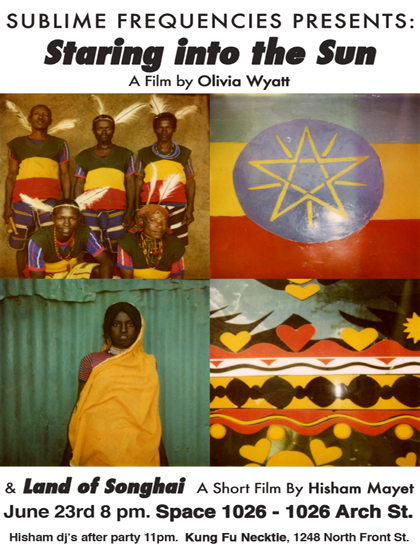
"Staring Into the Sun" by Olivia Wyatt


Promo info: "Staring into the Sun is the latest ethno-folk cinema classic from Sublime Frequencies. Ethiopia is known to be one of the oldest areas inhabited by humans and presently has over 80 diverse ethnic groups. Photographer/filmmaker Olivia Wyatt explores 13 different tribes throughout Ethiopia in this visually stunning film. Traveling from the northern highlands to the lower Omo Valley, Wyatt brings together the worlds of Zar spirit possession; Hamer tribal wedding ceremonies; Borena water well polyphonic singing; wild hyena feedings; and bizarre Ethiopian TV segments; presenting an enchanting look at these ethereal images, landscapes and sounds from the horn of Africa. The tribes featured in this film are captured with an unflinching sense of realism and poetic admiration resulting in a visual and aural feast of the senses." (italics by me)

watch the trailer here: http://vimeo.com/9468566

more pictures/info in one of the issues of XLR8R, pages 46-54: http://issuu.com/xlr8r/docs/xlr8r_131_single_pages

Thursday, May 27, 2010

Imperial Racism

Excerpt from Empire by Michael Hardt and Antonio Negri (courtesy of argh!)


The passage from modern sovereignty to imperial sovereignty shows one of its faces in the shifting configurations of racism in our societies. We should note first of all that it has become increasingly difficult to identify the general lines of racism. In fact, politicians, the media, and even historians continually tell us that racism has steadily receded in modern societies—from the end of slavery to de- colonization struggles and civil rights movements. Certain specific traditional practices of racism have undoubtedly declined, and one might be tempted to view the end of the apartheid laws in South Africa as the symbolic close of an entire era of racial segregation. From our perspective, however, it is clear that racism has not receded but actually progressed in the contemporary world, both in extent and in intensity. It appears to have declined only because its form and strategies have changed. If we take Manichaean divisions and rigid exclusionary practices (in South Africa, in the colonial city, in the southeastern United States, or in Palestine) as the paradigm of modern racisms, we must now ask what is the postmodern form of racism and what are its strategies in today’s imperial society.


Many analysts describe this passage as a shift in the dominant theoretical form of racism, from a racist theory based on biology to one based on culture. The dominant modern racist theory and the concomitant practices of segregation are centered on essential biological differences among races. Blood and genes stand behind the differences in skin color as the real substance of racial difference. Subordinated peoples are thus conceived (at least implicitly) as other than human, as a different order of being. These modern racist theories grounded in biology imply or tend toward an ontological difference—a necessary, eternal, and immutable rift in the order of being. In response to this theoretical position, then, modern anti- racism positions itself against the notion of biological essentialism, and insists that differences among the races are constituted instead by social and cultural forces. These modern anti-racist theorists operate on the belief that social constructivism will free us from the straitjacket of biological determinism: if our differences are socially and culturally determined, then all humans are in principle equal, of one ontological order, one nature.


With the passage to Empire, however, biological differences have been replaced by sociological and cultural signifiers as the key representation of racial hatred and fear. In this way imperial racist theory attacks modern anti-racism from the rear, and actually co- opts and enlists its arguments. Imperial racist theory agrees that races do not constitute isolable biological units and that nature cannot be divided into different human races. It also agrees that the behavior of individuals and their abilities or aptitudes are not the result of their blood or their genes, but are due to their belonging to different historically determined cultures. Differences are thus not fixed and immutable but contingent effects of social history. Imperial racist theory and modern anti-racist theory are really saying very much the same thing, and it is difficult in this regard to tell them apart. In fact, it is precisely because this relativist and culturalist argument is assumed to be necessarily anti-racist that the dominant ideology of our entire society can appear to be against racism, and that imperial racist theory can appear not to be racist at all.


We should look more closely, however, at how imperial racist theory operates. E ́ tienne Balibar calls the new racism a differentialist racism, a racism without race, or more precisely a racism that does not rest on a biological concept of race. Although biology is abandoned as the foundation and support, he says, culture is made to fill the role that biology had played. We are accustomed to thinking that nature and biology are fixed and immutable but that culture is plastic and fluid: cultures can change historically and mix to form infinite hybrids. From the perspective of imperial racist theory, however, there are rigid limits to the flexibility and compati- bility of cultures. Differences between cultures and traditions are, in the final analysis, insurmountable. It is futile and even dangerous, according to imperial theory, to allow cultures to mix or insist that they do so: Serbs and Croats, Hutus and Tutsis, African Americans and Korean Americans must be kept separate.


As a theory of social difference, the cultural position is no less ‘‘essentialist’’ than the biological one, or at least it establishes an equally strong theoretical ground for social separation and segrega- tion. Nonetheless, it is a pluralist theoretical position: all cultural identities are equal in principle. This pluralism accepts all the differ- ences of who we are so long as we agree to act on the basis of these differences of identity, so long as we act our race. Racial differences are thus contingent in principle, but quite necessary in practice as markers of social separation. The theoretical substitution of culture for race or biology is thus transformed paradoxically into a theory of the preservation of race.This shift in racist theory shows us how imperial theory can adopt what is traditionally thought to be an anti-racist position and still maintain a strong principle of social separation.


We should be careful to note at this point that imperial racist theory in itself is a theory of segregation, not a theory of hierarchy. Whereas modern racist theory poses a hierarchy among the races as the fundamental condition that makes segregation necessary, imperial theory has nothing to say about the superiority or inferiority of different races or ethnic groups in principle. It regards that as purely contingent, a practical matter. In other words, racial hierarchy is viewed not as cause but as effect of social circumstances. For example, African American students in a certain region register consistently lower scores on aptitude tests than Asian American students. Imperial theory understands this as attributable not to any racial inferiority but rather to cultural differences: Asian American culture places a higher importance on education, encourages stu- dents to study in groups, and so forth. The hierarchy of the different races is determined only a posteriori, as an effect of their cultures— that is, on the basis of their performance. According to imperial theory, then, racial supremacy and subordination are not a theoreti- cal question, but arise through free competition, a kind of market meritocracy of culture.


Racist practice, of course, does not necessarily correspond to the self-understandings of racist theory, which is all we have considered up to this point. It is clear from what we have seen, however, that imperial racist practice has been deprived of a central support: it no longer has a theory of racial superiority that was seen as grounding the modern practices of racial exclusion. Ac- cording to Gilles Deleuze and Fe ́lix Guattari, though, ‘‘European racism . . . has never operated by exclusion, or by the designation of someone as Other . . . Racism operates by the determination of degrees of deviance in relation to the White-Man face, which endeavors to integrate nonconforming traits into increasingly eccen- tric and backward waves . . . From the viewpoint of racism, there is no exterior, there are no people on the outside.’’ Deleuze and Guattari challenge us to conceive racist practice not in terms of binary divisions and exclusion but as a strategy of differential inclu- sion. No identity is designated as Other, no one is excluded from the domain, there is no outside. Just as imperial racist theory cannot pose as a point of departure any essential differences among human races, imperial racist practice cannot begin by an exclusion of the racial Other. White supremacy functions rather through first engag- ing alterity and then subordinating differences according to degrees of deviance from whiteness. This has nothing to do with the hatred and fear of the strange, unknown Other. It is a hatred born in proximity and elaborated through the degrees of difference of the neighbor.


This is not to say that our societies are devoid of racial exclu- sions; certainly they are crisscrossed with numerous lines of racial barriers, across each urban landscape and across the globe. The point, rather, is that racial exclusion arises generally as a result of differential inclusion. In other words, it would be a mistake today, and perhaps it is also misleading when we consider the past, to pose the apartheid or Jim Crow laws as the paradigm of racial hierarchy. Difference is not written in law, and the imposition of alterity does not go to the extreme of Otherness. Empire does not think differences in absolute terms; it poses racial differences never as a difference of nature but always as a difference of degree, never as necessary but always as accidental. Subordination is enacted in re- gimes of everyday practices that are more mobile and flexible but that create racial hierarchies that are nonetheless stable and brutal.


The form and strategies of imperial racism help to highlight the contrast between modern and imperial sovereignty more generally. Colonial racism, the racism of modern sovereignty, first pushes difference to the extreme and then recuperates the Other as negative foundation of the Self (see Section 2.3). The modern construction of a people is intimately involved in this operation. A people is defined not simply in terms of a shared past and common desires or potential, but primarily in dialectical relation to its Other, its outside. A people (whether diasporic or not) is always defined in terms of a place (be it virtual or actual). Imperial order, in contrast, has nothing to do with this dialectic. Imperial racism, or differential racism, integrates others with its order and then orchestrates those differences in a system of control. Fixed and biological notions of peoples thus tend to dissolve into a fluid and amorphous multitude, which is of course shot through with lines of conflict and antago- nism, but none that appear as fixed and eternal boundaries. The surface of imperial society continuously shifts in such a way that it destabilizes any notion of place. The central moment of modern racism takes place on its boundary, in the global antithesis between inside and outside. As Du Bois said nearly one hundred years ago, the problem of the twentieth century is the problem of the color line. Imperial racism, by contrast, looking forward perhaps to the twenty-first century, rests on the play of differences and the manage- ment of micro-conflictualities within its continually expanding domain.


full text here: http://www.mediafire.com/?mneqyomwd4n